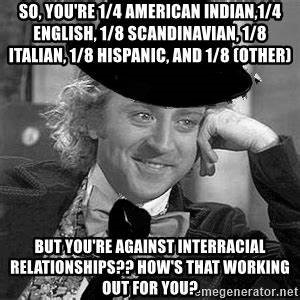
Do you remember that good old catchy Sesame Street song with three or more things that are similar and one of those things didn’t match? I remember singing that in my head as I formally met Kim’s family for the first time at Christmas. That in itself was a major event because prior to that, her whole family line – cousins and all decided to disown Kim when they found out she was marrying me. Her dad, a month before, said he’d never speak to her again and her brother wanted to punch me in the face. I warned Kim before we made the decision to marry that she may get persecutions, but she never wavered. Yet, she was surprised by the magnitude of the persecution in places that she never expected. Again, she stood against it all. This is one of the things about her that I will always love about Kim. A black man is told a lot, indirectly and unconsciously, that he is not worthy of such and such -whether it be education, country-clubs, etc., etc. We are told this a lot by the few discriminating ones who are vocal and not average good person who are the silent majority. It is so special to me that here is a woman who said by her actions that, yes, I am worthy of good things.
At the same time this was happening, Kim’s cousin decided that she was done with men and started dating other women – another shock to the family. Yet, Kim was confused as to why she gets a pass, (because the family wasn’t too keen about (LGBTQ and any other alphabet that fits, either.) When she asked her father about it, he replied, “I’d rather have a gay family member than a black family member (I’m sure he used another word for ‘black family member’)”. When I heard that he said that, the Sesame Street song pealed again in the back of my mind like a siren. I have always gritted my teeth at the comparison of race issues with gender issues. Even though they are both social issues, homosexuality and lesbianism is about morality, and race or color is about attributes. It infuriates me that certain people prostitute the race issue in an attempt to make the gender issue valid.
Case in point is the 2015 Supreme Court’s usurpation to legalize same-sex marriage. In an appeal to the Court the same-sex marriage is relevant, the petitioners cited the Loving v. Virginia, (dealing with the unlawful ban on interracial marriages) as an example to validate their case. (Obergefell p. 11) Basically, (I’m paraphrasing) it argues that the Loving case against Virginia (and other points) was unconstitutional, therefore they must consider same-sex marriage as unconstitutional) I’m, from time to time, confronted by gays and those sympathetic of making their causes legit use the race issue as a shoe in and I reject that. Don’t get me wrong, I love the person, just not some of their choices. And most important, I feel that lumping their agenda in with the race issue gives the impression that I agree with theirs of which I feel is wrong, which is not the case. Chief Justice John Roberts, who dissented from the decision, stated my point saying, “Removing racial barriers to marriage therefore did not change what a marriage was any more than integrating schools changed what a school was.” (Obergefell p. 16) Judge Samuel Alito, another dissenting vote, in his take on the same-sex ruling said, “It will be used to vilify Americans who are unwilling to assent to the new orthodoxy. In the course of its opinion, the majority compares traditional marriage laws to laws that denied equal treatment for African-Americans and women. The implications of this analogy will be exploited by those who are determined to stamp out every vestige of dissent.” (Obergefell p. 6) Issues like same-sex marriage will change the definition of marriage, indeed.
I felt slightly humiliated that Kim’s dad would rather put up with a homosexual than with a black man (from a moral point of view), but I continued with charity and love toward him, Kim’s family, and my fellow man. On Christmas morning, Kim was going to drop off her dad’s present, at her dad’s door. (since she wasn’t invited to their family Christmas). In seeing this, her father gave in and invited us in. This was the ice breaker. Over a short time, to mine and Kim’s surprise, her dad ended up loving me almost more than his own kids. (Kim will attest to that). In fact, he refused to go to family functions unless I was invited. That got me introduced to the rest of the family. Even though I didn’t make a complete transform of Kim’s family to like blacks, I did have an effect for the positive in most of their attitudes.
I decided to show her father who I really am, even through persecution and outrage, and that I am not just a stereotype. I have learned that righteousness and goodness shines through any form of ‘darkness’. Even as the world tries to make you change your mind over moral issues through legislation, criticism, or hate, I have learned that if you stand firm of who you are, if you stand for the right, you will shine forth, even to the dissolving of the darkness. In watching the video ‘The religious freedom implications of the Supreme Court’s decision on same-sex marriage in Obergefell V. Hodges’ (Dushku 2015), the backdrop has hanging a quote from Elder Dallin H. Oaks that sums up my blog: “Even as we seek to be meek and to avoid contention, we must not compromise or dilute our commitment to the truths we understand. We must not surrender our positions or our values” (Oaks 2014)
References
Obergefell el al. v. Hodges (2015). Opinion of the Court. p. 11. Supreme Court of the United States.
Obergefell el al. v. Hodges (2015). Roberts, C. J., dissenting. p. 16. Supreme Court of the United States.
Obergefell el al. v. Hodges (2015). Alito, J., dissenting. p. 6. Supreme Court of the United States.
Dushku, Alexander (July 7, 2015). The religious freedom implications of the Supreme Court’s decision on same-sex marriage in Obergefell V. Hodges. Religious Freedom Annual Review Conference. Brigham Young University.
Oaks, D. H. (November 2014). Loving Others and Living with Differences. Ensign
 Dane's Blog