Be yourself; Everyone else is already taken.
— Oscar Wilde.
This is the first post on my new blog. I’m just getting this new blog going, so stay tuned for more. Subscribe below to get notified when I post new updates.
Be yourself; Everyone else is already taken.
— Oscar Wilde.
This is the first post on my new blog. I’m just getting this new blog going, so stay tuned for more. Subscribe below to get notified when I post new updates.
Searching for an ad to redesign for my class project, I scanned quickly through the internet in search of a spark of inspiration. Of course, there is a sea of products to choose from. I hoped I wouldn’t have a hard time picking one out. It wasn’t long until my eyes fell upon a familiar commodity that I knew would be a great product whose ads would be great to redesign. It’s good ol’ familiar Clorox.

I simply saw the ad on Pinterest, of all places, and was immediately caught by the phrase “Works like Clorox, smells like ALOHA!’ [insert image] …. What?! That was a weird way at putting words. After about a minute of processing in my mind, trying to understand the phrase, it came to me as I played it out in my mind of using Clorox. It works like Clorox is known to work, but you don’t get that distinctive chlorine smells on your laundry that has become synonymous with bleach.
I knew from that point on that this ad was what I wanted to recreate. This ad was created for the average person who uses bleach, which is about everyone. As I said before, I got this ad from Pinterest, so I don’t know the designer who created the ad, but I like his or her thought. Whoever thought up this ad decided to use a little discretion when it comes to addressing its issue – which is its smell. That person knows that there is no “un-crass” way to say, “Hey! we made fart smell like lilac!” Of course, I am not saying the smell of the gas chlorine is comparable to the smell of the gas methane, but I believe you get the metaphor.

As I went about trying to formulate ways to redesign this ad, I noticed the key elements to design – that is contrast, repetition, alignment, and proximity. I make it an acronym of C.A.R.P. for carp, which could mean fussing over details. It’s not the greatest of acronyms, but I like it far better than C.R.A.P.! Getting back on point, the typography uses contrast to set apart each line of phrase, from size changes, to font and color changes that immediately tell how the phrase is supposed to be said. The shine from behind the mostly transparent bottle distinguishes and shapes it so that you get the illusion of a bottle and that it really stands out even though it is supposed to blend in with the scene. Clever.

There is even a small design element of repetition in this ad. Aloha and the background repeat to give you a sense of Polynesia and the shine from the bottle and the shine from the logo highlight its recipients respectively. This also makes it the centerpiece of the whole ad. The whole background is in sync with the Aloha text that gives off the warm tropical feel.

Every bit of the text is center-aligned so that your eyes stay right in the middle. This helps to locate the vanishing bottle and more importantly, the Clorox logo. Speaking of the logo, it is aligned with the rule of thirds position. I’m not sure if that was instinctively done that way, but it does seem to work with keeping my eyes there.

As far as proximity goes, everything in this ad naturally clusters with its own kind, the slogan stays of in its space in the upper middle. the logo and its information stays confined on the bottle. Proximity in this ad keeps things simple and logical. I see that the slogan bunched all its words at the top so that the rest of the ad is more about the experience than words. I believe this helps to keep things discrete. Can you smell it now?

I transferred all of those qualities over into my redesigned ad with the difference in repetition. My repetition is in the meaning of “fresh”. There is freshness in the word “A-a-a-ah!”, there is freshness background and in the coloring. Although this ad presents a different mood, it presents the same discretion and purpose. That is what the advertiser wants – variety. I believe I accomplished the task of recreating an ad that I think that the Clorox Corporation would use in its arsenal of ads.
by Dane Woodruff COMM 130
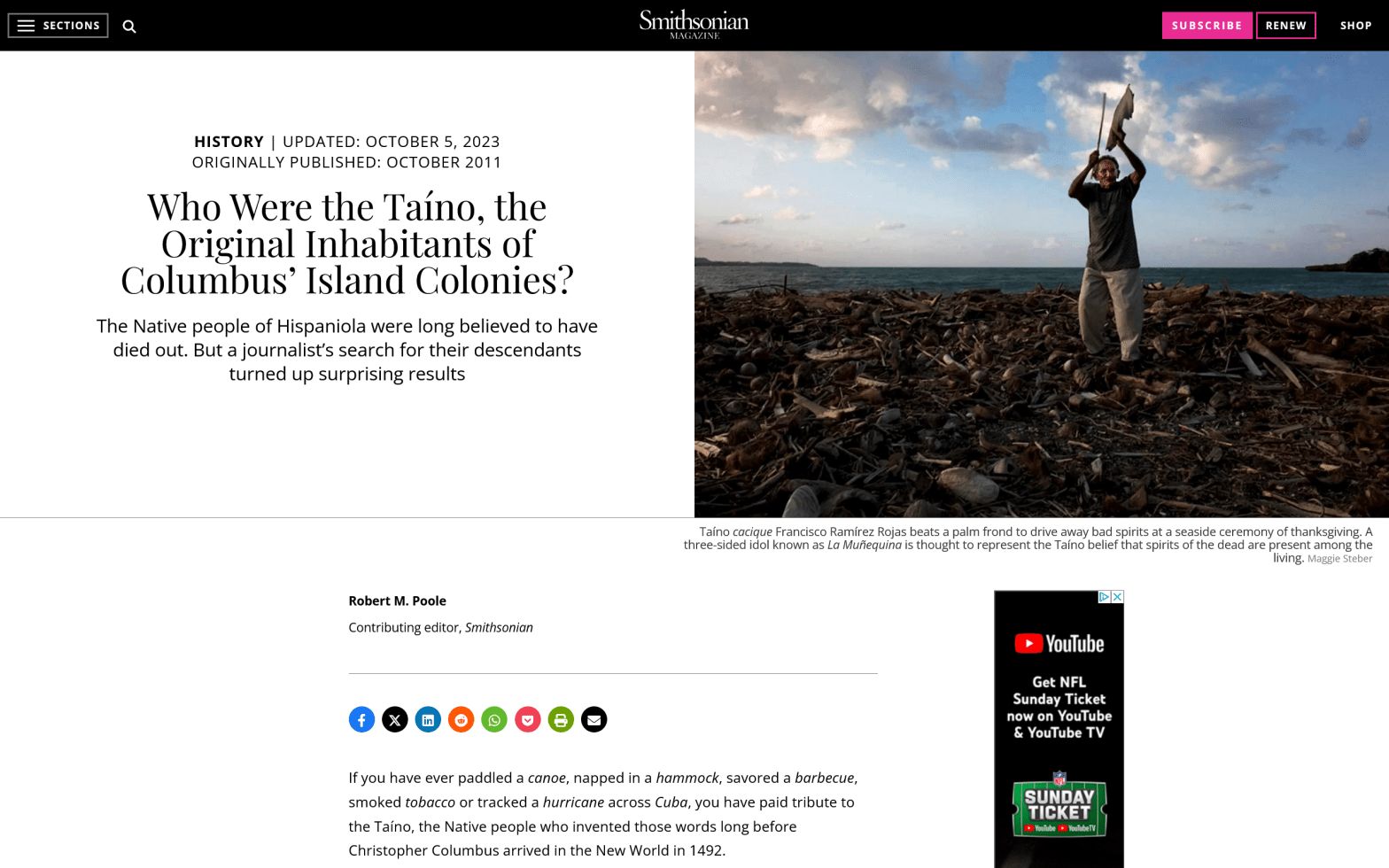
I was set out this time to find a magazine to critique for certain design elements. I was kind of concerned about this assignment because I don’t see people going around with magazines in their hand. That has been replaced with the latest cell phone and TikTok-like apps that leave the archaic magazines in the dust. So, I concluded magazines sold their soul and went electronic, or in other words, you’ll find them online. I came across this one and was about to click away from it, but there was something about it that bugged me. I now had to investigate.
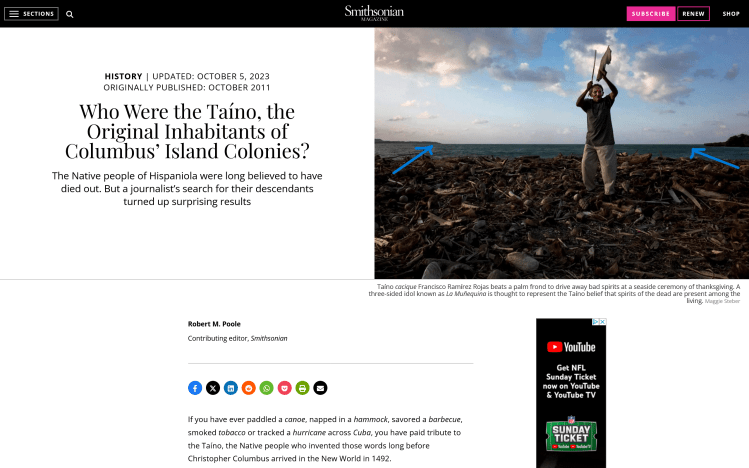
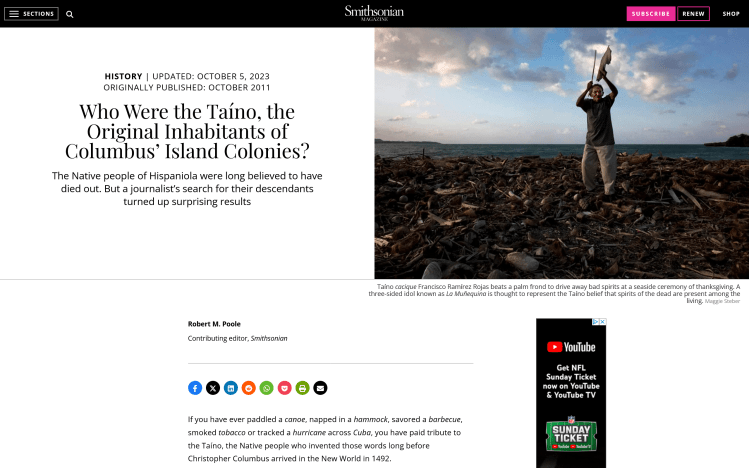
The first thing that caught my eye was the striking field of depth which contrasted and brought that insignificant looking man out of obscurity and made him the focus of the subject matter. He was even positioned somewhat in the rule of thirds. I also noticed that everything in the column has a center-alignment. Oh wait! The main body of the paragraph (not fully shown) has a left-alignment, but a thin black ad pops up on the right, off-setting the left-alignment and making it feel central again. My bad. So what was bugging me about this layout? I even created three photos to match the power of this photo’s field of depth. My amateurism shows compared to the photographer who took that picture. (all pictures were shot from my Samsung Galaxy S10 phone)



Although my photographs are a bit amateurish, you can still see the power of field of depth accomplishing the task of bringing the subject to become the focal point.
So, if the magazine layout is okay and the image is good, perhaps what is bugging me is in the typography.
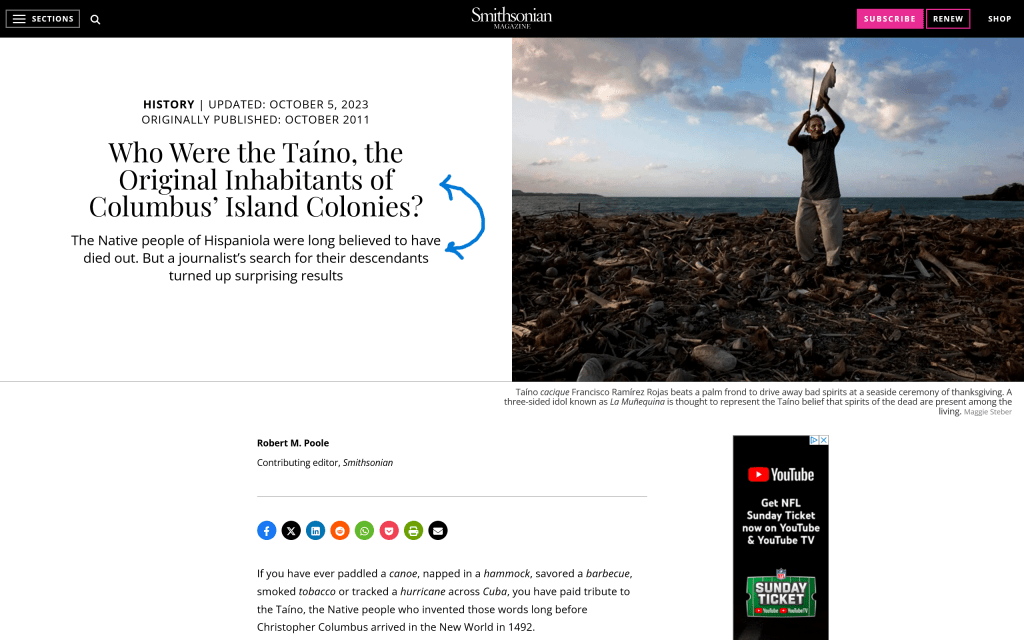
I see that there is good contrast between the title (which seems composed of the tall Modern type “Book Antigua” against what appears to be the squat San Serif “MS P Gothic.” I immediately know what the title is, even being sandwiched between two plain text lines. Even the “Smithsonian Magazine” logo has good contrast and a daring move in using all caps for the smaller text. But in further noticing the logo, it hit me as to what is bugging me.
Although everything looks good with the execution of this design, what stands out is the logo’s lack of “standing out”. It dwarfs almost into obscurity in the top center. Also, the only stand-out colors besides the images are on the links to somewhere else. It leaves me with this taste in my mouth that Smithsonian is not serious about promoting itself. The Smithsonian Institute has always been about some serious science and other interesting subject matter. Shouldn’t that reflect on their magazine design? Maybe they are just being modest. Seriously!
by Dane Woodruff COMM 130
Introduction:
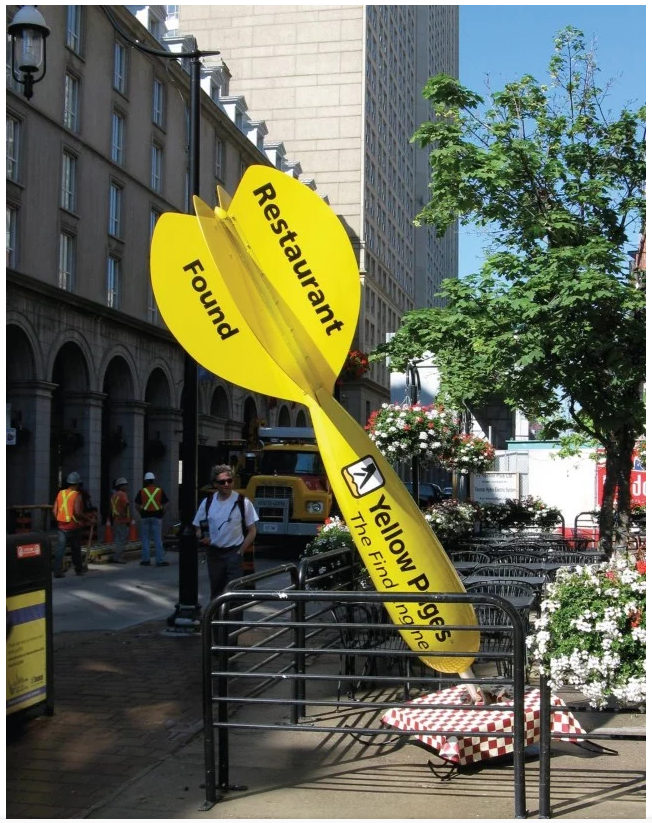
In search of an advertisement for my school research on the 5 elements of design, I came across an ad from the Yellow Pages that did a fantastic job in using these design elements. I found it on Pinterest at https://www.pinterest.ca/pin/90846117453953553/. The 5 elements of design are contrast, repetition, alignment, proximity, and color. Here are the findings on this great ad.
Contrast:
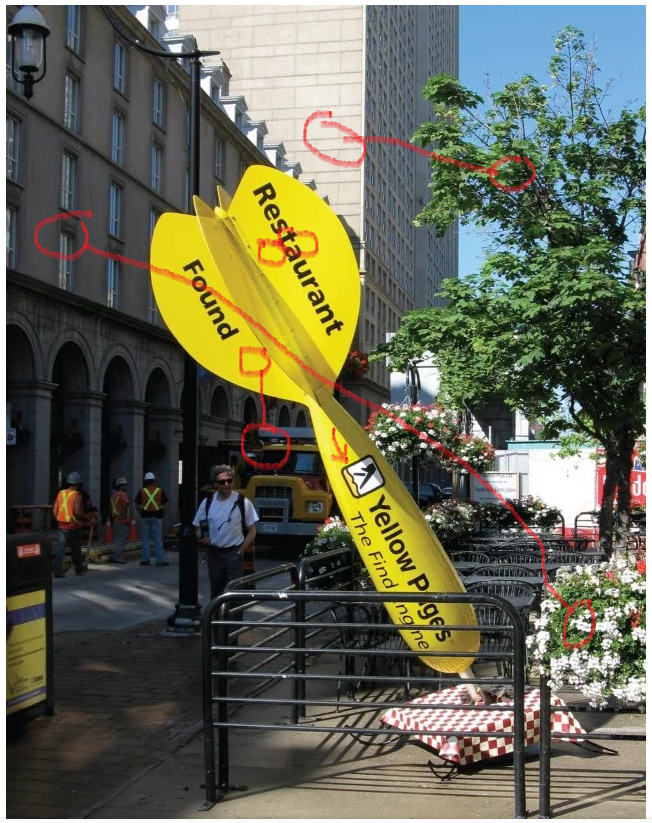
This ad screams with contrast, the most obvious one is the bright yellow dart against the dark, shadowy left side of the dart. Even within the dart there is contrast with the dart itself and the black lettering, making the words stand out so that you clearly know who the ad is from. There is even contrast of environment on side side of the dart than the other side. The left side is dark with people seemingly dealing with a problem. The right side of the dark portrays a bright carefree nature. This subliminally suggests that the Yellow Pages will make life rosy and bright for you with their help. The sky even contrasts as there is conflict with orderly perspective on the left and chaotic flora on the right. And finally, the white logo stands out near the center to set the focal point for the viewer eyes.
Repetition:
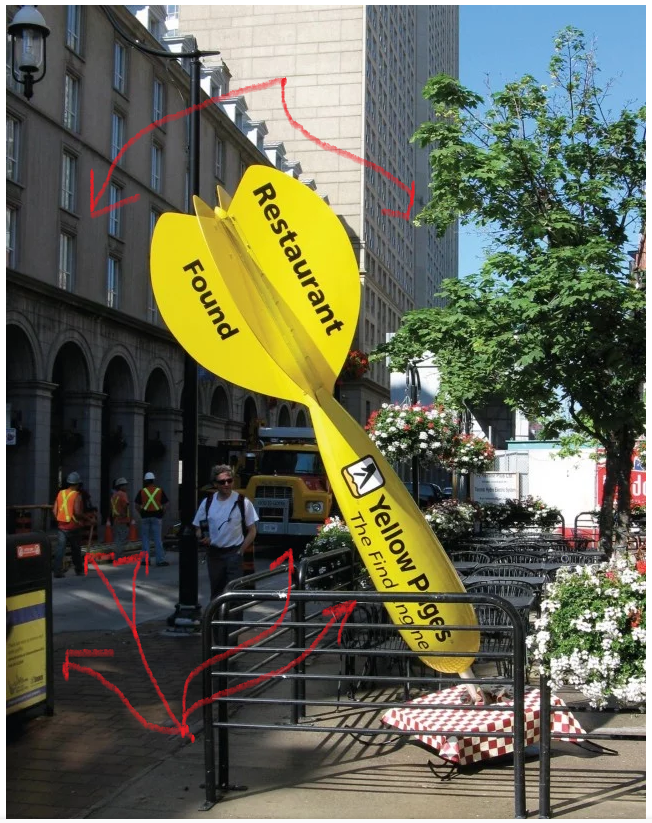
Here, repetition serves a function in this ad. The repetitive and diminishing perspective of the columns and windows give off the effect of endless city, but the dart still manages to hit its target. The yellow plays an interesting role in causing movement around the ad. The dart tend to move your eyes diagonally downward and off the page. Then the yellow poster on the left move your eyes back around to the yellow crosses on the safety vests, then to the yellow truck, and then back to the dart. This circular activity will have you reading the ad over and over. (which is what advertisers want)
Alignment:
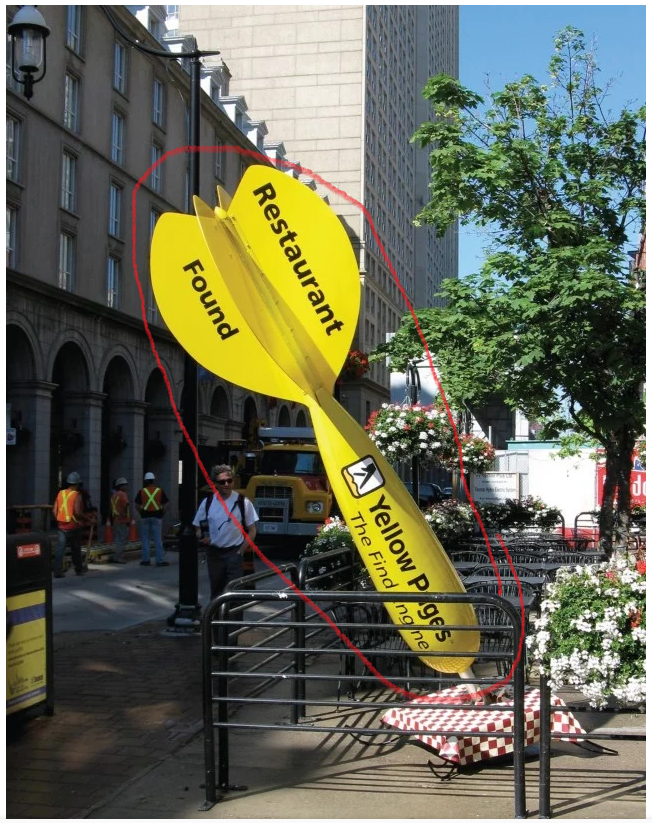
With the lettering aligned with the dart, you understand that the lettering belongs to the dart. It actually defines the dart and tells the story for this ad. The dart itself, being out of alignment and disproportional, turns this scenario into surrealism in an instant.
Proximity:
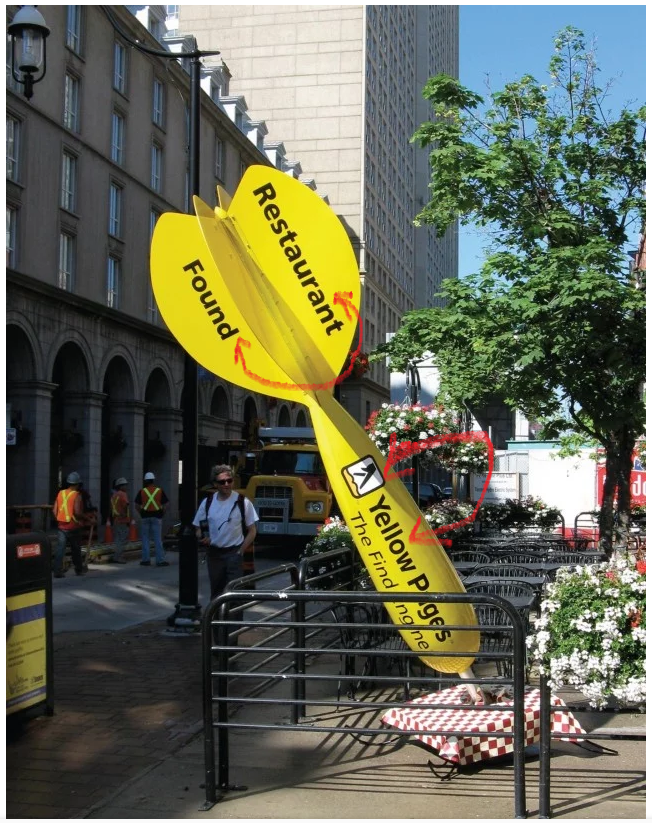
With the two words grouped at the tail of the dart, you see that they form a short and simple message, which explains the purpose for the dart. The Yellow Pages in approximation over The Find Engine tells you that The Find Engine defines what the Yellow Pages is. The Yellow Pages besides the logo establishes its relationship with each other.
Color:
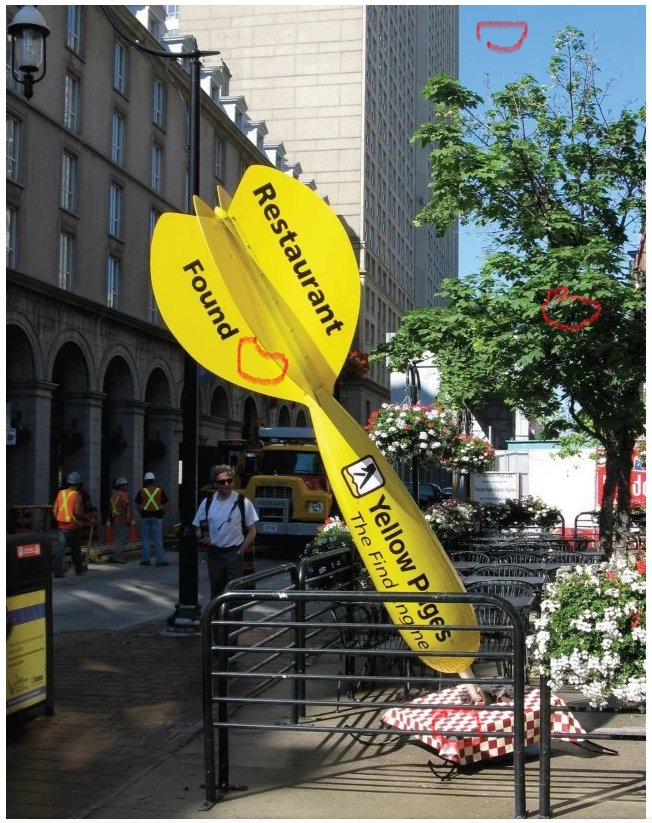
Here, the use of primary and secondary colors shows the color of everyday life ( with the exception of the giant yellow dart). The recognizable shade of yellow on the dart form a subtle repetition with the logo and lettering that tells you who the company is.
Conclusion:
All in all, the design elements of this ad really make it a surreal work of art by giving you a ton of advertisement with only 7 words. Everything else tells the story of how the Yellow Pages can be a source of finding places, whether remote or impossible to find. The use contrast, especially, has made this ad a design masterpiece.
“Can there any good thing come out of Nazareth?” That was the passage in John 1:46 that went across my mind as I stepped out of the bar/brothel on 5th Ave. in the Hill District ghetto. Being careful not to step on used hypodermic needles, left behind by drug users, I maneuvered down the steps and walked back out to the vehicle where I left my wife and kids. I suddenly stopped to behold the intense contrast my new, shiny van being dwarfed by the backdrop of gray, daunting, dilapidated buildings of the ghetto. What was more startling to me was looking at my shaken wife and kids huddled in the van, looking apprehensive out at the scene around them. You would have thought they were swallowed by a whale. That’s when it occurred to me that my wife and kids have never experienced the ghetto. It also made me see why I left Pittsburgh in the first place, and a stark reminder of why I landed in the glorious bosom of the Church of Jesus Christ of Latter-Day Saints.
To answer the tacit question of why I visited a bar/brothel, it wasn’t because I was giving patronage to it, but I came there to visit my uncle, who owned the establishment (I didn’t get to see him, though. He wasn’t there). He was one of the round-of-relatives on my list to see while visiting the places where I grew up. I came back to Pittsburgh with my family to show them my past and my side of the family. We covered a wide berth, finding as many of my siblings, nieces, and extended relatives we could who still lived in Pittsburgh. Kim, my wife, was taken by feeling like she was “one of the family”. It was so alien to her for extended family to be so close. In her town, where we live, all of her relatives live close by, but they barely speak to each other (well, except at funerals).
The downside of visiting my family is for socio-economic reasons. Since I have a car, I’m expected to be a jitney (sort of like an urban taxi – without the fare). They also think of me as a piggy bank. Hands are always out asking to spare this or that amount. I wouldn’t mind as much if I had the spare change and I knew it wasn’t going to cigarettes or drugs. I guess this is why I love my family at a distance. I made the mistake of bringing my brothers down to Tennessee to get them away from the ghetto (a promise I made with them when we were young that if I got out of the ghetto, I’d help get them out). Yet, they ended up bringing the ghetto down to Tennessee. (much to my dismay and embarrassment).
Even though our extended family is vastly different from each other, the one thing that my wife and my in-laws have in common is the tendency to vie for their loyalty. They both use the cliché, “Blood is thicker than water”, as if to say the extended family’s ways trumps our own family, even when doing questionable things (Kim’s family aren’t so innocent, either). They are foreign to the concept that President Spencer W. Kimball has counselled, “Couples do well to immediately find their own home, separate and apart from that of the in-laws on either side. The home may be very modest and unpretentious, but still it is an independent domicile. Your married life should become independent of her folks and his folks. You love them more than ever; you cherish their counsel; you appreciate their association; but you live your own lives, being governed by your decisions, by your own prayerful considerations after you have received the counsel from those who should give it. To cleave does not mean merely to occupy the same home; it means to adhere closely, to stick together.” (Harper 2005)
I am so grateful for Kim, who was willing to stick together with me, even to enter a ghetto with me, and put up with my family. We have withstood the pressures of “in-law drama” and held fast to what we believe in and each other. As a result, our in-laws respect us and our ways. That, of course leaves us to be lonely at times, if it weren’t for my church brothers and sisters, who have their own kind of drama. Oh well! We can’t have everything.
References
Harper, J. M. & Olsen, S. F. (2005). “Creating Healthy Ties With In-Laws and Extended Families.” In C. H. Hart, L.D. Newell, E. Walton, & D.C. Dollahite (Eds.), Helping and healing our families: Principles and practices inspired by “The Family: A Proclamation to the World” (p. 328). Salt Lake City, UT: Deseret Book Company.

In over twenty years, I can honestly say that my wallet has never housed a fifty-dollar bill. Oh, I remember the days when my wallet was full of money and I felt the freedom to do whatever I wanted to do – not that I would, but that I could. What a good feeling that was. It’s ironic that over the years there was a transformation of my wallet being fat and me being skinny, to my wallet becoming skinny and me getting fatter. What happened? My suspicion lies when I got married to Kim. That’s when the transformation began.
Not that I’m complaining, mind you. It’s just a mere observation of mine. I was aware of what I was getting myself into when I got married. I remembered the lessons about marital authority or, what I call, “power struggles” that are repeated from time to time from the Church leaders. One in particular, by Pres. Gordon B. Hinckley, really caught my attention. He said, “In the marriage companionship there is neither inferiority nor superiority. The woman does not walk ahead of the man; neither does the man walk ahead of the woman. They walk side by side as a son and daughter of God on an eternal journey” (2002). When I look at what he said at face value, the idea is so simple and elegant. But in my reality, the idea was such a contradiction in my life and what I was taught from childhood on.
I was, with no exception, taught as a child that the man was “the head or authority of the home”. Yet, societally, I grew up in an era of “women empowerment” – especially for the black woman. With governmental support for women’s rights and educational scholarships (none for men!) – with the supposed intention to better the lives of women as well as the attitude spread among women that “you can’t depend on a man”, for which I am personally an “ear-witness” to – caused an unintentional rift or change in the balance of power, especially among blacks. You could google sites like these: https://www.theroot.com/black-women-now-the-most-educated-group-in-us-1790855540 , the Journal of Blacks in Higher Education (https://www.jbhe.com/news_views/51_gendergap_universities.html) or the American Psychology Association ( https://www.apa.org/workforce/publications/13-demographics) if you think I am exaggerating.
Such “power struggles” entered my first marriage with a black woman and that eventually was a key factor in the dissolution of our marriage. (I say that with sadness – for I feel like a failure, even though at the time, I felt powerless) Then I remarried with Kim. Kim left a marriage in which she felt she had no power. She, too, felt controlled and had very low self-esteem. She was unhappy. After all, she was the oldest of her sibling brother. She was the alpha-female. When she got to know me, she saw that I was different than her former husband (I know all this because, well, she told me). Yet, because of ethnic, economic, cultural and peer differences, I began to see “power strugglings” beginning to surface between us, especially in raising kids and finances.
The difference this time was the words of the General Authorities (GA’s) that you and your spouse are “equal partners”. I still remember the day when Kim and I came to an impasse about finances. I wanted to conserve. She wanted some breathing room. I remembered vividly how I swallowed my pride and slowly handed over the checkbook to her (keeping the words of the GA’s in mind). Even though I was the breadwinner, I’ve learned to compromise. It wasn’t easy for me, but I knew it was good for her.
Twenty years and 7 kids later, I look into my anorexic wallet and wonder if I made the right choice. After all, if I had done things my way, and everything had gone accordingly as planned, we’d be totally debt-free. We’d be on easy street. But alas, we still struggle from day to day. I must say, though, that there was one dividend that came out of this – the growth of my wife. Pres. Hinckley said of his wife: “I’ve tried to recognize my wife’s individuality, her personality, her desires, her background, her ambitions. Let her fly. Yes, let her fly! Let her develop her own talents. Let her do things her way. Get out of her way, and marvel at what she does…If there is anything that concerns me, it is that some men try to run their wife’s life and tell her everything she ought to do. It will not work. There will not be happiness in the lives of the children nor of the parents where the man tries to run everything and control his wife. They are partners. They are companions in this great venture that we call marriage and family life.” (2003) I look at my wife’s transformation and confidence, and it is striking how much she has grown. Yes, it was and is definitely worth it, to me.
Still, the man in me wants to withdraw some money and go buy a double cheeseburger without having to get consent from my wife. I’ve worked hard to earn that right. It’s my money anyways! On second thought, I’d better strike out this last paragraph before my wife reads it.
References
Hinckley, G. B. (2002). Ensign. Personal Worthiness to Exercise the Priesthood. p 52.
Hinckley, G. B. (2003). Ensign. At Home with the Hinckleys. Longing for Family Joy pp. 22, 27.

It was in the most unlikely place where I learned a profound lesson on how to view the opposite sex. Back in 1987, while attending the Mission Training Center (MTC) in Provo, Utah, a concerned missionary asked the General Authority who was addressing us (I believe it was J. Richard Clarke), how can he keep his mind pure when a lady walks past him in a pretty outfit? The reply went something like: “If you look once, you’re normal. If you look twice, you’re in trouble. If you don’t look at all, you’re homosexual!” Bursts of laughter filled the MTC after the third point, which we all knew was said in humor (or was it?). Anyways, I took from it that the beauty of a woman is not a bad thing. It is okay to have feelings of attraction to a woman.
You’d think that naturally goes without saying, but I’ve lived in a world of taboos, “Thou shalt nots”, or criticisms of women toward men that caused paranoia within me to even say the word ‘female’ and ‘sex’ in the same sentence without feeling shame or embarrassment. And to be honest, it was hard be to intimate when I first got married. I had to shake the program in my mind that sex and intimacy were bad (after 6 children, I think managed to overcome it.). In an article by Sean E. Brotherson, speaking on ignorance and inhibitions, he says, “Many husbands and wives who have an adequate understanding of sexual matters in marriage still struggle to overcome negative thoughts or feelings associated with the expression of sexual love.” (2003) That was certainly me.
In my determination, I set forth to work on my mental state and remind myself that it is okay to “look once” and to have frank conversations about sex and things intimate. In doing so, I’ve come to see women in a fuller light. I see that the most beautiful thing about women is that it is endless. Like the endless varieties of flowers, who can say one flower is prettier than another? One may prefer a certain style, but each flower has its own individuality. This is why I dislike beauty pageants. It gives the notion that one beauty is above another. In reality God is trying to tell us that some things are eternal, like beauty (read the lyrics of the LDS hymn “If You Could Hie to Kolob”). I just look at all the women in my Family 300 class, they are all beautiful and it tells me that there must be a God. Their pretty faces couldn’t have been created by accident. But I’m digressing. The point is, I can enjoy “looking once” without going too far.
But the question comes, what is considered too far? What happens when you “look twice”? For that answer, ask those who are addicted to pornography. I have two children who have had a problem with it. True, not all people will be affected as others, but you would be amazed how overwhelming the internet can be. It doesn’t take long for it to happen and it is accessible. Looks can transfer into actions. That is how we are designed. Just remember to stay within the bounds the Lord has set and you’ll be okay.
You can also go beyond “the look”. In 2006, a woman made national news by fatally shooting her preacher husband in the back. Her name is Mary Winkler, from Selmer, TN. (not far from where I live) One of her reasons for her actions was that he made her wear a wig and “slutty” costumes. I’m not giving an opinion on the case itself. I am more concentrating about everyone’s reaction to her husband’s demands for intimacy. I understand the importance of respecting her, but are we, on the other hand, that mortified to justify killing a man over it?
I was so intrigued by the media’s portrayal of the event, that I actually polled people on this. Of the 10 or so people I talked to 4 black women found nothing wrong with dressing up for their man. The few white men I asked, they were unanimous in being afraid now to ask their woman for anything, that it was another way for women to control them. The white women, on the other hand (including my wife) was mortified that Mary were treated that way. Through my polling, I saw how ethnicity/peer influence can affect the way we think. Mary got off with a light sentence. I simply just told my wife that I am ignorant of how to be intimate and she shows me what to do. Best thing I ever did.
References
Brotherson, S.E. (2003). “Fulfilling the Sexual Stewardship in Marriage”. Meridian Magazine, http://www.meridianmagazine.com.

Being a big-city boy, steeped in ethnic black culture, and married to a small-town girl from a very racist family line – you would think we would clash due to those differences. We clash alright, but it is from the same issues I’ve dealt with from my first wife (keeping a clean house, finances, and other personal concepts we clashed with.) In fact, in the book “The Seven Principles for Making Marriage Work”, John Gottman calls these personal concepts “dreams”, “By dreams, I mean the hopes, aspirations, and wishes that are a part of your identity and give purpose and meaning to your life” (p. 238) It is amazing to me that something so small and seemingly insignificant as “dreams” are the cause of so much friction in a marriage instead of seemingly bigger influences like culture and environment.
Perhaps our Church and its ability to make its members “peculiar” is the culprit. (1 Peter 2:9) Peculiar nowadays means “odd” or “strange”. But the origin of the word is Latin for “one’s own”. I’ll use it as “the Lord’s own special brand of people.” I recall a time when my fellow choir members and I went out to the country to rehearse with another singer for the choir. I imagined a puzzled neighbor hearing country from across the farm yard, then comes rolling up a black man in his car listening to R&B music, then a Puerto Rican roll up in his car listening to Latino music, and then the man of house comes out and they all start singing, “I am a Child of God”. In this Church you’ll see doctors and lawyers alongside janitors and nursery workers and people of all various walks of life, coming together for a common cause. (especially in the temple) What is it that makes us so peculiar?
The book “Drawing Heaven into Your Marriage” may give us a clue as to how this is so. In quoting Marvin J. Ashton, a former General Authority, H. W. Goddard cites, “Perhaps the greatest charity comes when we are kind to each other, when we don’t judge or categorize someone else, when we simply give each other the benefit of the doubt or remain quiet. Charity is accepting someone’s differences, weaknesses, and shortcomings; having patience with someone who has let us down” (p. 116) It is sad that the one virtue that is essential to get into heaven (Ether 12:34) is so uncommon as to make those possessed with it ‘peculiar’. True charity, or the pure love of Christ ignores our differences and regards everyone the same – a child of God.
This one point has caused me to marvel at those who are religious and racist. (believe me, there are more of those than you think) If a person is trying to get back to Heavenly Father and he or she can’t tolerate being with any other race, how will they endure Heavenly Father’s kingdom that has infinite races? (read the last line of “If You Could Hie to Kolob”). I personally believe the great gulf that divides heaven and hell is the people’s ability to tolerate one another. I also believe that this is one of the reasons why marriage was instituted – that we may learn to tolerate one another. As Goddard puts it, “Marriage is ordained to stretch and refine us” (p. 134)
When I look at any of my wife’s (or my children’s) improprieties or differences, I just remember that she, like me, is a child of God. Don’t get me wrong, I’m not ignoring the issues, I just look at how my wife was when we first got married and see that she has grown tremendously, and so have I (especially in the stomach area). I see that changing your perspective on how you view your wife is a form of charity. It has made a huge difference in my marriage. People in the past has accused me of being a charity case. Well, for this form of charity, I plead guilty.
References
Goddard, H.W. (2009). Drawing Heaven into Your Marriage. Conclusion. Cedar Hills, UT. Joymap Publishing. p. 134.
Gottman, J.M. and Silver, N. (1999). The Seven Principles for Making Marriage Work. Principle 6: Overcoming Gridlock. New York: Random House LLC. p. 238.
(Ether 12:34) And now I know that this love which thou hast had for the children of men is charity; wherefore, except men shall have charity they cannot inherit that place which thou hast prepared in the mansions of thy Father.

I’ll never forget the time when I was investigating the Church, during Sacrament Meeting, when this sweet 8 or 9-year-old girl arose up onto the stage and stood by the piano. She held up to her chin a violin and proceeding to play. I was struck with amazement. For I have never seen or heard anything like this before. She played beautifully to the degree that when she finished, I immediately stood up with a Wo-hoo!, That was Great!, and about three claps – only to hear my applause echo back to me with about 100 stares. I had no clue that you were not suppose to clap during Sunday meetings. I was raised up to applaud when you were impressed with a performance, even at church – well, not this Church! I slunk back down onto the pew, hoping to hide under it. Later, a smiling member came up to me and patted me on the shoulder saying, “Dane, I honestly can’t remember actually seeing a black man blush until now.”
Thirty-something years have passed. I am married to a woman whose parents did all the work, the kids (my wife and her brother) wanted for nothing. If they talked back to their parents, the worst that they would get is a “go to your room”. I grew up where we 6 kids did all the work. We always were wanting. If we talked back to our parents, I probably wouldn’t be here today writing this blog. My wife’s difference in raising children obviously clashed with mine. I was convinced my way of “walk softly, but carry a big stick” was the way to go. She held on to her perception of “walk loudly, and hope that that sticks”. about raising kids. To settle the score, we took marriage classes at school to help settle the differences. Under my breath, I self-righteously whispered to myself, “she’ll see that I’m right. The lessons we’ll learn from school will back me up.” I was certain that I was correct because culture has taught me, other members, tradition, El-Hi schooling, TV, and even my interpretation of the scriptures. Instead, we were both wrong. We were both taught a more convincingly a better way to parent. I slinked back down under the proverbial pew.
Recently, I was assigned to read from H.W. Goddard’s “Drawing Heaven into Your Marriage”. In the back of my head I kept thinking, “What am I doing wrong this time?” Sure enough, in typifying marriage to the Law of Consecration, Goddard said, “Consecration has everything to do with marriage. It is much more than “staying for the kids.” It is acting to redeem our partners and our covenants with everything we have and everything we may draw from Heaven. We do all of this in order to establish Zion in our homes.” (p. 104) In fact, that whole chapter, I believe, was writing about me, especially the part that said, “…the natural spouse is an enemy to marriage.” Who would have thought that a natural person, who is just wanting some happiness, would be an enemy to marriage?
While I mused on that point, I thought about a light bulb, if it doesn’t give us it’s total commitment, it does us no good. I get it. I’m more concerned with the fact that I am again and again relearning the correct way of being, or in other words, becoming like the Savior, who “drank the bitter cup” and sacrificed his happiness for all of our happiness. I thought I was doing the right things all along. Who’s standing at the crossroads of my life, to show me the better way? Perhaps I need to realize that if there’s someone standing at the crossroads, he or she may be in the same predicament as I am. Perhaps I’ll do something more novel, like reading the posted signs. Meanwhile, I’ll just slink back down under the proverbial pew and hang there for awhile. I spot a gum wad stuck underneath, I wonder if it still has any flavor left in it.
References
Goddard, H. W. 2009. Drawing Heaven into Your Marriage. Joymap Publishing. Cedar Hills, UT. Consecration. p. 104-105.

My hands were sweating as I carefully unsealed the letter to see where I was going to serve. I quickly scanned down to where I was called to go. The letter said I was going to the Tennessee Nashville Mission. I was going to the South – the home of the KKK! While my friends and peers gathered around family and revealed the exciting locations they were called to go to, I knelt down alone in an attic. For I, the proverbial Casey, struck out at the bat. In my prejudice did I condemn myself: Why would the Lord send me, a black, Mormon yankee (that’s already three strikes against me) to his death sentence? Nevertheless, not my will be done. I went on my mission. Evidently, I didn’t die. (although I was threatened and chased out a town by the Branch President) Instead, I’ve learned the great wisdom of the Lord in using me to help ‘perfect the Saints’ in that area. My testimony and work helped change a lot of attitudes. This was told to me by a former Bishop (who then was the Temple President) I served under.
I’m sure people can see that it is a no-brainer that I have been acquainted with prejudice. I was a little unsure about how Kim, my blonde Southern belle, (and my children as well) would handle discrimination now that she is married to a black man. We ended up more surprised by those to whom we didn’t expect discrimination from. Sure, we expected it from her family side. But we didn’t expect it from our own daughter and members of the Ward. My wife was so hurt when the young women would hold everyone’s babies, but not ours, or the whispers that got back to us of how so and so disapproved of our marriage. But, what really struck me with amazement came from a black leader in the community. He said I could not help in black led activities because I’m a ‘Mormon’. This made me reflect deeper in the meaning of prejudice.
Pride manifests itself in so many ways, but it never been so obvious as in the form of prejudice. Usually when a person hears the word ‘prejudice’, it is usually associated with race. Yet, prejudice can be associated with gender, religion, or politics. It’s friendly to the rich, as well as the poor. It mingles in our wards and congregations. It creeps in among the unintentional and rages with the intentional. It even invades our homes and family. Pres. Ezra Taft Benson gets right to the heart of in all when he warned us, “The central feature of pride is enmity – enmity toward God and enmity toward our fellowmen. Enmity means ‘hatred toward, hostility to, or a state of opposition. It is the power by which Satan wishes to reign over us.’ (1989) When I see all of these experiences I afore mentioned as a form of enmity, I am no longer surprised.
I remember way back of an interview of Donny and Marie Osmond with Barbara Walters on the subject of blacks not holding the priesthood. It seems the world was condemning the Church for that reason while Donny and Marie were sweating bullets trying to explain why. I kept thinking how ironic it was that the media was putting the Church as prejudiced against blacks, when in actuality, the Church has the only answer on earth that has a remedy of pride and prejudice. It is the Book of Mormon. The book talks about enmity of a white and black race of people and how they dealt with each other. “Now when the Lamanites saw that their brethren would not flee from the sword, neither would they turn aside to the right hand or to the left, but that they would lie down and perish, and praised God even in the very act of perishing under the sword – Now when the Lamanites saw this they did forbear from slaying them: and there were many hearts had swollen in them for those of their brethren who had fallen under the sword, for they repented of the things which they had done.” Alma 24:23-24
Humility and repentence is the key against pride and prejudice. Who would have guessed?
References
Benson, E.T. (May 1989). Beware of Pride. https://www.churchofjesuschrist.org/study/ensign/1989/05/beware-of-pride.
The saying is true that “No one cares about what you know until they know how much you care.” This statement holds true in the workplace, in raising my children, and especially in my relationship with my wife. This was a confusing concept for me to grasp, at first. In my youth, I survived living in the ‘hood by using my intellect. I dodged the bullies and jealous idlers, who hated seeing a man trying to get ahead. I outwitted abuse and overcame neglect with knowledge. I even had to compete with the bias of the black women I encountered and dated that I was smart enough to get ahead in this world.
It comes as a surprise to me when I arrive home from a hard day’s work, open the door, and immediately get pummeled by the events my wife encountered throughout the day. (A slight exaggeration, but you get the point) I barely get to smell the scent of home before I hear about something that got broken, the fight she had with a daughter, money, etc. Of course, in my pursuit to alight in a comfy chair I rely on my tried and true intellect to quickly rescue my wife from all her woes and troubles, but I really just want to sit down. I give her this advice to fix this thing, I advise her what to do about that child. No effect. My wife continues her onslaught.
I would then hold back the offense that my wife had just thrown away my precious knowledge – knowledge that took so long for me to acquire, such sacrifice to obtain, and much diligence to achieve. Usually, I’d get frustrated and slightly offended by what I would perceive as my wife’s lack of confidence in me. I’m not saying I have all the answers of the universe, but it’s nice to feel acknowledged for the little bit that I do know. But, I have learned from past experience and many lessons from Church and classes that it’s a losing battle to justify yourself by being sarcastic or offensive in some way or another to retaliate.
Recently I read something from my marriage class that reminds me of how I truly should be when it comes to controlling myself. It is a paragraph entitled, “Replacing evil with goodness” (Goddard 2009) where basically, it gives a parable of how the Lord cast an evil spirit out of a boy. Then goes on to say, “It is not enough to cast out evil. We need more. …It takes faith in the Lord to remove evil from our marriage and bring them to vibrant life”. (p. 55) It’s language like that in which I keep mindful of how I should be to my wife. Not only do I keep my mouth shut, but I must do as what another class lesson taught me, and that is: turn toward each other instead of away from each other. “Turning towards”, John Gottman says, “operates under the law of positive feedback – like a snowball rolling downhill, it can start small, yet generate enormous amounts” (2009, p. 89)
So, in order to “turn toward my wife” and support her, I look straight at her and can only get out a mere “mhmm” as she yammers on. Then suddenly, a change comes over my wife. Her eyes and emotion brighten. She speaks with more intent as she notices that she actually has my attention and not vying for it. I say a few more “mhmm”’s – not in casual listening, but to keep myself from solving her problems, or telling her it will all be okay. The “mhmm”’s seem to navigate well through the myriad subjects she’d switch to on a spur of the moment. They would also avoid the mindreading that we men sometimes are faulted for not doing. There is no sarcasm suspected or anything suspicious about an “mhmm”. It keeps me behaving right. It is direct, honest, and just simple. (Men like simple).
While I mused on this magical word, a thought comes to mind of my cat that constantly likes to rub up against me. I’d say, “Go away Adonis, I know you want loving, but I’m busy now”. Then it hit me. A cat has its own way to communicate and say’ “I love you”, so does my wife. With that thought in mind, I continue with the “mhmm”’s and before you know it, my wife is happy, relieved and unburdened, going about doing her next bit of business. I sit down, shout out to my wife that I love her and pet the cat.
(edited by Heidi Roemmele)
References
Goddard, H.W. (2009). Drawing Heaven into Your Marriage. Replacing evil with goodness. Cedar Hills, UT. Joymap Publishing. p. 55.
Gottman, J.M. and Silver, N. (1999). The Seven Principles for Making Marriage Work. The Purpose of Marriage. New York: Random House LLC. p. 261.

 Dane's Blog